
Planning a Vertical Garden: What to Decide Before You Start
"Structural load, light levels, water drainage, and the fatal mistakes in felt-pocket systems."
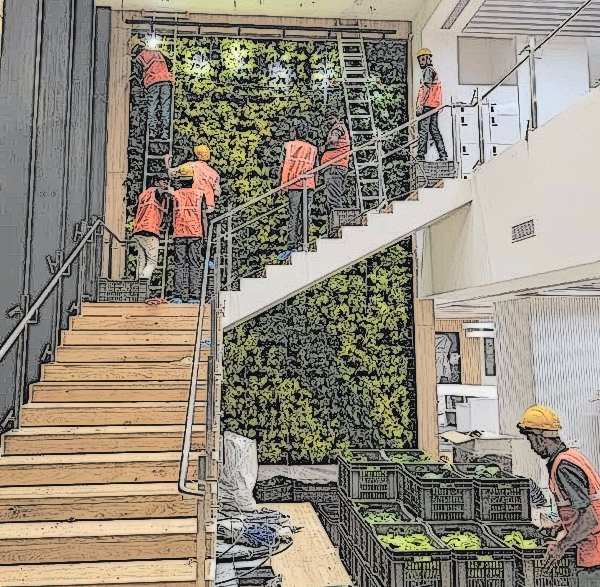
Light is Non-Negotiable
The single most common cause of living wall decline is insufficient photosynthetic active radiation (PAR). Indoor species require at least 1,200 to 1,800 Lux sustained across 10 hours daily.
If your reception atrium or cafeteria lacks natural skylights, specialized 4000K–5000K horticultural track luminaires must be engineered into the ceiling layout before wall installation.
Why Felt-Pockets Fail and Cassettes Endure
Early living walls used fabric felt pockets. Over time, moisture causes felt to decompose, roots rot, and replacing a single dead plant tears adjoining root networks.
Star Gardens utilizes UV-stabilized rigid polymer cassettes. Each specimen grows in its own ventilated pod with automated drip lines feeding the root zone directly. A single pod can be inspected or swapped in 30 seconds without disturbing the living wall.
"Always demand rigid cell systems with sealed drip collection gutters to protect building walls from moisture intrusion."
— Star Gardens Horticultural Advisory
Zoning Plants by Micro-Elevation
A 5-metre tall vertical wall has distinct microclimates. The top receives more light and heat, while the bottom gathers cooler moisture. Top zones are planted with resilient Dracaena and Epipremnum, while lower zones thrive with humidity-loving Boston Ferns, Syngonium, and Calatheas.
Star Gardens Editorial Desk
Bengaluru, Karnataka · 70 Acres Nurseries in Punganur, Rajahmundry & Madikeri